Showing posts with label Japanese. Show all posts

Saturday, 1 March 2025

Goldfish review | Arts House

Goldfish is a striking collaboration between Tasmanian puppetry company Terrapin and Japan’s Aichi Prefectural Art Theater. It’s a playful yet thought-provoking exploration of nature and climate, urging audiences to reflect on the lasting impact of human action (or inaction).

The play begins with Mayu Iwasaki using shadow puppets to tell a story. Dylan Sheridan’s layered sound design and Greta Jean’s delicate puppet creations lull us into a hypnotic dreamscape, making the opening moments feel otherworldly. But that tranquillity is soon shattered when two volunteers from a Disaster Response Coordination Team (CRDT) burst into the theatre announcing that a flood has hit the city, and we - the audience - are now evacuees.
Saturday, 18 November 2023

Butoh Bar 番狂わせ OUT of ORDER review

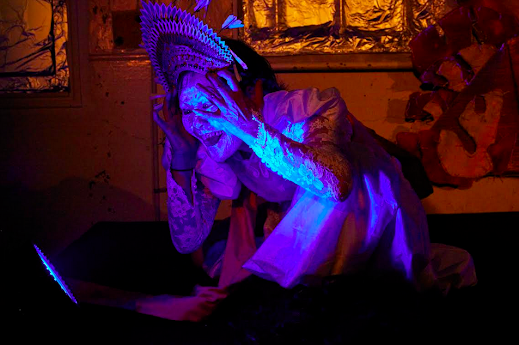
Simply walking into ButohBar 番狂わせ OUT of ORDER is an experience on its own. It feels like we have entered an underground, post-apocalyptic dive bar. Chairs are scattered around the space, various art installations are positioned on the floor or projected onto the walls and drinks and food can be ordered at the makeshift counter. There are roving performers and there are resting performers - lying on chairs, sitting at an altar and even hidden within a box. These initial encounters immediately succeed in setting the scene for the artistic collective of ButohOUT! to present, inform, inspire and enlighten its audience with what butoh is and its potential to bring change.

Thursday, 23 March 2023

IN-VOCATION たまおこし review

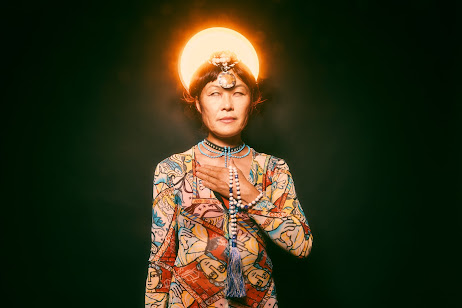
After an utterly incredible show with Buried TeaBowl - Okuni last year, performance artist Yumi Umiumare returns with IN-VOCATION たまおこし, a potent pairing to the 2022 show. With its predecessor exploring time, ritual, the past and the present through her connection to Okuni, a 17th century Japanese dancer credited as being the founder of kabuki theatre, this new show digs deeper into Okuni's life, with a focus on releasing the "Okuni spirit" inside all of us.

Joining Umiumare are two Japanese artists, Kayo Tamura, a shaman in theatre and Kyoko Amara, a professional clairvoyant and singer. This trio perform music, dance, rituals and storytelling as they share and discover the many characters of Okuni. With the Japanese title of the show translating to provoking / awakening the soul, it's fitting that a shrine to the womb sits in the middle of the stage as the three build and release the female power and energy of Okuni. They go big and bold in their acts but maintain an intimacy and authenticity with their audience that allows us to open our minds and hearts to what we are witnessing.


Thursday, 29 December 2022

Top 10 Shows of 2022

It was a much welcomed return for live shows in 2022. The intimacy, connection, and engagement with a variety of works was much needed after the last couple of years. From theatre to dance to live art, from satire to comedy to drama, it was an exciting time once again for the Melbourne independent performing arts scene. With "only" 90 pieces of work seen this year, my top ten is merely an indicator of the fantastic works that were put on in 2022, and try as I might, it just isn't possible to see everything, especially while travelling for ten weeks! If I reviewed the show, a link to the review is provided.

And as I always like to remind people, sometimes the shows that will stick with you months and years after you've seen them, that will leave an imprint on your mind, body and soul, will not always be the big budget, flashy ones but the ones that are only on for four nights with ten people in the audience. Support your independent theatre makers and venues - some shows can cost you as little as $20 and can be one of the most original, inspiring and though provoking performances you might see.

Take a risk, seek something new, unknown and different in 2023.

Here we go:

Monday, 9 May 2022

Buried TeaBowl - Okuni review

I've seen Yumi Umiumare perform numerous times over the years but always as part of the ensemble in someone else's show. Buried TeaBowl - Okuni is the first time I have attended one of her full solo works and I am very disappointed I waited so long to have had this incredible experience. Incorporating dance, spoken word, song and a tea ceremony, this performance installation is an intimate and stirring passage through time, ritual, the past and the present.

These four themes are clear in Umiumare's inspiration for her show: a 17th century Japanese dancer, Okuni, who is credited as being the founder of kabuki theatre. Literally translated to "the art of song and dance", Okuni began performing kabuki around Kyoto in the early 1600s and formed an all-female troupe that portrayed both male and female characters. Kabuki eventually became equated with prostitution and immorality and in 1629 this outrage led to a Government ban on women performing kabuki that was not lifted until the late 19th century.

Sunday, 15 September 2019

The Unfolding of Benjamin’s Misery - Melbourne Fringe Festival review

Winner of the Liverpool Poetry Slam 2018, spoken word performer and poet, Hideto Ambiguous brings his show, The Unfolding of Benjamin’s Misery to the Melbourne Fringe Festival. Hideto weaves a tale involving immigrants, exploitation and racism as we follow Benjamin, an undocumented immigrant, who is stuck working in a performance venue for an ungrateful employee who takes advantage of his situation. 

With no lighting, sound, set pieces or props, Hideto places everything on his own shoulders to engage the audience and for the most part he manages to do this quite well. His original songs and poems, including "Everyday Dissident", leave you considering the role we play - and have played - in embracing the "other", which is particularly fitting given the multicultural hotspot that is Melbourne. 

The main problem with this performance however, is the portrayal of the characters, with Benjamin and his boss Martin played as highly exaggerated caricatures. While this could work if it were only Martin to emphasise his cruelty, we are never able to sympathise with Benjamin because of this heightened comic effect. With Benjamin taking the role of narrator and this story being partially based on Hideto's own experiences, it feels like The Unfolding of Benjamin’s Misery is trying to do too many things for a story that relies on truth and simplicity. A more natural depiction of Benjamin would garner the emotional response that it sets to achieve and allow the conclusion to make a stronger statement to the audience.

Friday, 5 July 2019

The Intriguing Case of The Silent Forest review

A young girl has been murdered and a Detective and his team have only seven days to locate The Tongue-Cutter in the suspense filled production of The Thursday Groups' The Intriguing Case of The Silent Forest. With its use of a number of theatrical devices and actor training methods, the show is a powerful and confronting exploration of pain, sorrow and the ability to heal within a noir setting.

From its opening moments, the cast (Rodrigo Calderón, Matthew Crosby, Kathleen Doyle, Eidann Glover, Alana Hoggart, and Lorna McLeod) deliver committed and convincing performances that never wane or falter. It's an ensemble that is very much tuned in to each other, which is crucial given the physical nature of the show.

Wednesday, 18 April 2018

Absolutely Normal - Melbourne International Comedy Festival review

Showko - “Laughing Child” in Japanese - is the number one rakugo performer in Australia, and she returns to the Melbourne stage with her show, Absolutely Normal. Disappointingly, Showko is the only rakugo performer in Australia, as this art form is so rich on imagination and creativity that it would be great to have the opportunity to see it more often. Originating in Japan, rakugo is a 400-year-old traditional form of comic storytelling using minimal props with the performer kneeling on a cushion. Movement, action and characters are all conveyed through body language, voice and facial expressions.

Dresser in a shiny silver yukata, Showko warms up the audience with some anecdotes about life in Japan and Australia. They are stories of the everyday but her enthusiasm makes them seem far more exciting than they are, which could be considered a lesson in how to approach and appreciate rakugo. This pays off for the audience when it comes to her rakugo story about a cherry tree that allows us to easily be transported into the world she describes.

Tuesday, 21 February 2017

Kagerou - Study of Translating Performance review

In 2011, Japan was hit by its most powerful earthquake ever recorded. With a magnitude of 9.0 - 9.1, it triggered a huge tsunami and resulted in the deaths of over 16,000 people and left thousands more injured. Referred to as "The Great East Japan earthquake" it was a devastating blow for Japan, with sympathies and aide coming from around the world.

In Kagerou - Study of Translating Performance, director Shun Hamanaka uses the story of Kyoko Takagi - a woman in her 70s who lost her husband in the tsunami - and attempts to explore how sympathy and connection between strangers can be born from a tragedy such as this. Hamanaka has opted for a minimal set design, having just three chairs on stage with video footage being projected onto a screen with some effective shadow work by lighting designer Hiroshi Isaka, emphasising the documentary-style of the performance.

Saturday, 11 February 2017

Time's Journey Through a Room review

The inaugural Melbourne festival Asia TOPA is the opportunity for Australia to celebrate the contemporary arts with its neighbouring Asian countries. Time's Journey Through a Room comes to Melbourne from Japanese theatre company chelfitsch, and is a meditative and meaningful exploration of life, death, the in-between and the hereafter. Written and directed by Toshiki Okada, the performance is set a few days after the 2011 earthquake and Fukushima nuclear accident, but if you think the performance is going to be about those events think again. Okada instead focuses on the relationships a young man has with his deceased wife and his new girlfriend.

The cast of three - Izumi Aoyagi, Mari Ando, Yo Yoshida - deliver deeply nuanced performances in roles that on the surface do not seem to demand much, but the subtleties of their characters and the delicate spoken nuances are where the complexities of hope and hopelessness are explored. There is a significant emotional detachment present by the performers throughout the show that is well-balanced and effectively manifested.